MCP Server Architecture for Analytics Data Access
Pre-modeled datasets and governance rules must back up your MCP analytics server.
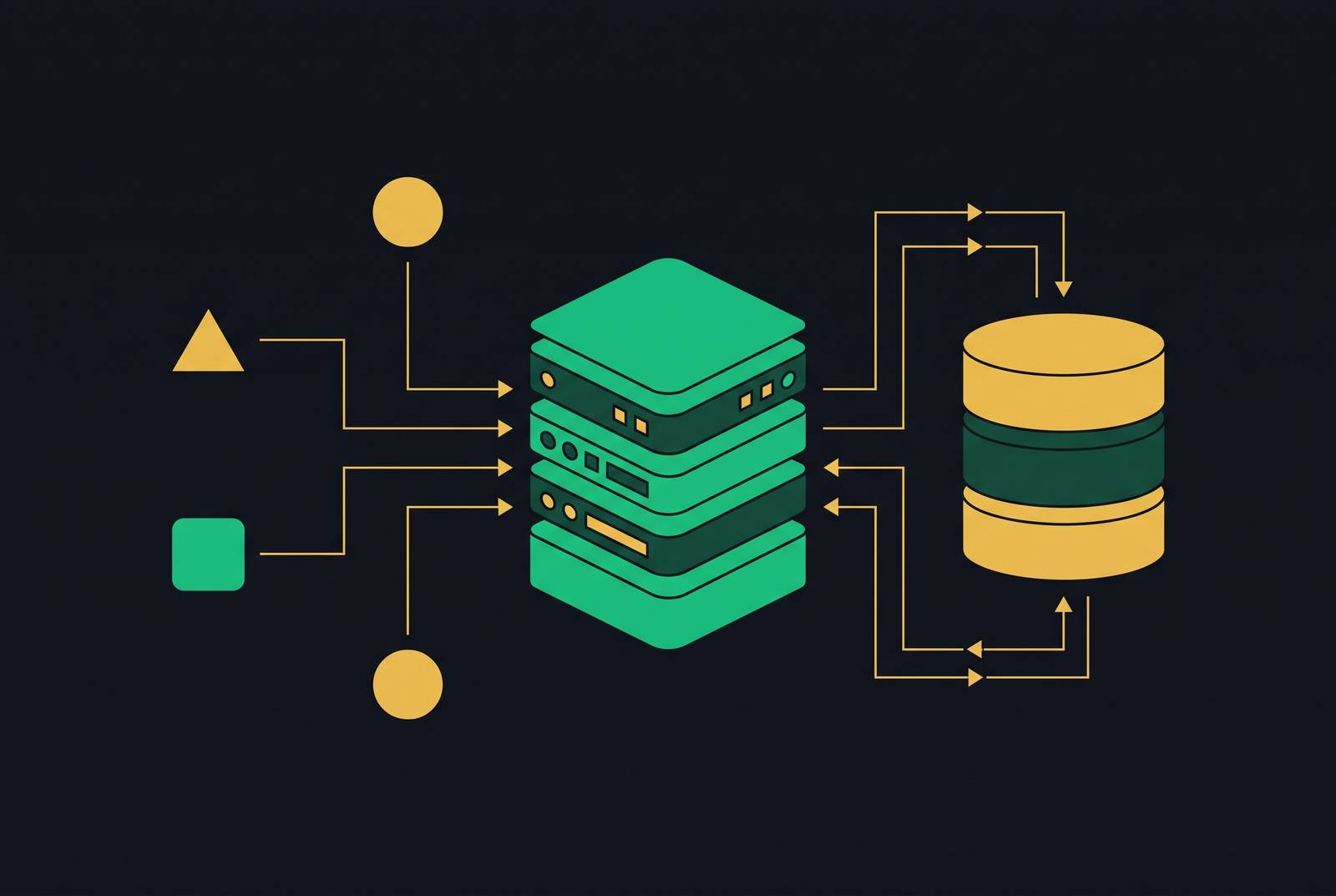
MCP server architecture for analytics data access works reliably when agents query pre-modeled, governed datasets. For API-first and agent-first teams, a headless analytics backend should expose those datasets through MCP or APIs without tying access to a particular frontend. The protocol standardizes tool calls, but trustworthy answers and production protection depend on the data layer.
What the Model Context Protocol actually standardizes — and what it leaves to you
MCP tackles the N×M integration problem by giving clients and connectors a common interface so each pairing no longer needs its own integration. It separates the AI client, such as Claude, ChatGPT, or Gemini, from the MCP server containing connector logic and the underlying resource, such as a database or API. Messages use JSON-RPC 2.0, and servers expose tools, resources, and prompts through a standard interface. This makes connectors portable across compatible clients. It does not make their results correct.
A tool can accept a valid request and still return a poorly defined metric or data the caller should not see. As agents make more calls, they bring naming gaps, permission gaps, and conflicting definitions to light faster. Governance therefore has to sit upstream of tool execution, in the datasets and controls those tools use. Pre-modeled, queryable datasets, such as those Dreambase exposes to agents, address a different responsibility from the protocol itself.
How the 2026-07-28 stateless spec changes the scaling calculus for analytics servers
The 2026-07-28 specification makes MCP stateless, removing the initialize/initialized handshake and the Mcp-Session-Id header from Streamable HTTP. Each request includes its protocol version and client capabilities in _meta, while the lists of tools, resources, and prompts are now the same for every connection. Any request can therefore go to any server instance behind a standard round-robin load balancer. This makes it easier to scale the tool tier horizontally. Servers that need state across calls must create explicit handles and pass them as ordinary tool arguments.
The same revision gives gateways more control over requests. Mcp-Method accompanies every POST, while Mcp-Name accompanies tools/call, resources/read, and prompts/get, enabling per-tool budgets without parsing JSON bodies. Authorization also changes. Clients must validate a present iss parameter when returned, credentials are bound to their issuing authorization server, and Dynamic Client Registration is deprecated in favor of Client ID Metadata Documents.
These changes make the serving tier simpler, but analytics still needs state. Identity, query jobs, cost caps, and audit trails must be kept in durable systems. A shared data layer is a natural place for that state, and Dreambase’s pre-calculated metrics and governed datasets show how humans and agents can share data this way. Apache Doris MCP server and Spice document support for the revision, making this an implementation concern.
Why an analytics MCP server built on raw production data fails in production
A direct production connection makes an analytics prototype easy to assemble, but it puts agent demand on the same database that serves the application. One agent flow may request metadata, retrieve a metric contract, run a query, validate freshness, and inspect lineage before answering. A question is not necessarily one database request. Across automated workflows, that multiplication can turn an unoptimized production database into a service-tier bottleneck.
Connection capacity makes the risk concrete. When analytics work competes for database connections with application work, an otherwise useful tool can become a source of contention. Read-only access does not remove that competition. A standard tool interface also leaves expensive queries just as costly and lets an overprivileged caller see just as much sensitive data. Performance controls and access restrictions must be in place beneath the interface.
Each ad-hoc query can become an isolated definition of “Churn” or “Active User,” so humans and agents calculate the same concept differently. An agent may produce a technically valid answer that conflicts with the dashboard a founder uses. Without a shared semantic definition, fixing one query leaves the next interpretation unresolved. Metric drift then erodes confidence in the entire analytics system.
What a governed data layer provides that the MCP protocol cannot
A governed data layer turns business definitions and access rules into executable constraints. It pre-calculates metrics against an agreed definition and gives humans and agents the same modeled dataset. The calculation happens before the agent asks. This removes the need for each tool invocation to reconstruct business logic from raw tables, while making the result independent of which consumer requested it.
Access enforcement must be equally concrete. Row-level security limits returned records to those the agent is authorized to see, while column-level masking redacts sensitive fields within otherwise permitted results. A fraud detection agent can get transaction amounts and timestamps without seeing payment card numbers or customer names. Published JSON tool schemas then define allowed operations, typed parameters, and structured errors. These contracts give agents a known interface and errors they can use to replan.
Data Product MCP, described in a 2026 arXiv paper, offers a contract-compilation pattern that turns data contracts for access control and governance policies into real-time checks before queries run on cloud data platforms. AI-driven checks stop queries that break those policies before they run. The contract is an enforcement boundary connecting what a tool claims to permit with what the data platform will actually run.
An immutable audit chain completes that boundary by linking what the business needs to know, governing policies, generated query, and results. Reviewers can then examine both the action and the rule that authorized it. For teams introducing this architecture, the practical starting point is metadata plus one KPI tool before open SQL. That keeps the initial surface focused on analysis access.
How enterprise teams are structuring the MCP gateway in front of multiple data servers
Enterprise deployments place a gateway in front of multiple MCP servers to centralize authentication, audit logging, discovery, and routing. Agents receive one endpoint and permission-scoped tool visibility rather than unrestricted access to every downstream service. That visibility follows identity. The gateway can enforce shared access rules so each server has no need to build a full security layer of its own.
Behind the gateway, a four-layer server design separates transport from tool routing, schema validation, and authorization checks. The domain layer holds the business logic, while the infrastructure layer holds the drivers, adapters, and API clients. Business logic remains protocol-agnostic. This separation allows transport changes, tighter authorization, or new integrations without entangling adjacent layers.
For enterprise identity, the recommended pattern is for only the enterprise IdP to issue MCP server tokens, rather than relying on per-user OAuth redirects at scale. Agents receive the fewest privileges needed, with a defined workflow for increasing scope mid-task. Each call has a log of its inputs, outputs, and policy decisions. The new request headers also let the gateway enforce tool-specific rate limits and cost budgets without inspecting JSON bodies.
Informatica announced fully headless capabilities through native MCP support at Informatica World on May 20, 2026. Its approach exposes data management capabilities as reusable, governed services that agents can invoke. This illustrates the enterprise use case for headless access.
Applying this architecture to Supabase — what does its MCP server expose, and where does it need reinforcement?
Supabase’s MCP server provides genuine operational access with meaningful safety controls. Its read_only=true setting executes queries as a read-only Postgres user, making the restriction a PostgreSQL role boundary. The hosted service uses OAuth 2.1 with automatic token refresh and requires no local server, binaries, or hardcoded credentials. These are substantive safeguards for database tooling. They do not, however, define the business meaning of a result.
The observability surface is also substantial. Supabase exposes query logs through SQL, PostgreSQL metrics covering CPU, IO, WAL, connections, and query statistics, live database stats, and security and performance findings across its operational interfaces, including MCP. Supabase Queues provides a native queue system built on pgmq, while advanced caching requires manual Redis setup. The MCP server does not include a built-in analytics dashboard.
For a custom production deployment, the recommended topology separates the MCP server into an independent, stateless HTTP service, using Supabase for context persistence and authentication. Supabase Realtime supports event-driven context updates, while Edge Functions suit lightweight MCP endpoints without high throughput. PostgreSQL row-level security provides tenant isolation. Each request should also send its method, context size, duration, and Supabase latency to a separate observability sink.
These capabilities make Supabase MCP useful for operational work without making it a complete analytics backend. Nothing in the server itself pre-models business metrics or enforces their semantic definitions. An agent asking “what is MRR?” still needs an agreed calculation.
Why pre-modeled, pre-calculated datasets are the right unit for agent-facing analytics
Pre-modeled datasets move metric computation out of the request path. Metrics are calculated ahead of time, stored as governed Parquet files, and queried through DuckDB, so production Postgres is not touched at query time.
A single definition of activation, MRR, churn, or retention feeds both human dashboards and agent tool calls. When both consume the same calculated metric from the same dataset, they do not introduce competing calculations at query time. A single MCP server can give agents access to only those governed datasets, so agents have no need for production credentials. Metrics can also be calculated on a consistent cadence and pushed to inboxes, Slack, or dashboards.
Dreambase implements this pattern for Supabase projects by pre-modeling Postgres data into Parquet datasets queryable through DuckDB and exposing them through a single MCP server. It serves human teammates and AI agents from that shared layer, without ETL, schema changes, or new infrastructure. For teams adding usage analytics to an agent without a prebuilt dashboard UI, the relevant capability is access to modeled datasets over MCP and APIs. A frontend becomes a consumer.
The use-case distinction is therefore clear. Supabase MCP provides operational database access, Informatica addresses enterprise-wide governed data management services, and Dreambase provides pre-calculated analytics for Supabase-native teams. Its stage-specific metrics include activation and cohort retention before the product meets market needs, MRR components and logo churn during early traction, CAC, LTV:CAC, and NRR during repeatable growth, and segment retention and gross margin at scale. Founders get numbers they can trust and safe access for agents without needing a data team of their own.
The practical checklist for evaluating any MCP analytics architecture against these requirements
Published tool schemas must spell out the allowed operations, typed parameters, and error structures in JSON. Agents need this contract to replan when a request fails.
Identity controls must map each agent identity to a specific database role with scoped permissions, excluding shared superuser credentials.
Query controls must enforce cost caps and have a kill switch in place before expensive requests reach production.
Immutable invocation audits must record an invocation ID and SQL hash for every tool call in an audit sink. These records make agent actions reviewable and support reproducibility after the request has completed.
Pre-modeled metric definitions must give everyone who uses them the same agreed calculation, so raw-table queries no longer have to supply the business logic. When those using the same tool get conflicting MRR figures, it shows a gap in semantic governance.
Production isolation must keep production database credentials out of agents’ hands and let them reach only governed datasets through the analytics server. This separates permission to analyze business data from permission to access the operational system.
Stateless server design must align with the 2026-07-28 specification and keep session identity, query handles, and audit records in durable systems. This allows horizontal scaling without making correctness depend on which server receives a request.
Observability must instrument every MCP request with its method, context size, duration, and latency and send those signals to an external sink. Without traces, teams cannot reliably diagnose where an agent’s path from question to answer broke.