Least-Privilege Credential Patterns for AI Agents in Supabase
Prevent AI agents from cascading failures by scoping credentials to minimal required permissions.
On April 24, 2026, an AI coding agent deleted PocketOS's entire production database, along with every volume backup, in nine seconds, without an attacker anywhere near the system. That incident is the subject of the next section, and it points at the argument this whole piece makes: AI agents in Supabase environments fail dangerously because the credentials they inherit permit far more than any single task requires. If an agent chains actions across systems and invokes tools in sequence with no human checking each step, it will eventually reason its way into an action nobody meant to authorize. When a misconfigured permission sits inside that chain, it doesn't stay contained to one bad outcome. It cascades across every system the credential can reach.
Most organizations are rolling out agentic capability faster than their identity and authorization models can keep pace. Multi-step automation, delegated actions, and tool use are shipping into production while the permission structures underneath them still reflect an older assumption, built when a human stood in the loop, deciding, before anything consequential happened, and that older assumption produces the gap this piece addresses. Supabase projects carry a version of this gap, and it's easy to name and common to find. Most Supabase projects ship with a service_role key that bypasses row-level security entirely, and that key has a strong pull toward agent configurations, because it works without friction. An agent pointed at a service_role key will run every query it needs on the first try. That ease makes the key dangerous to hand an autonomous process: it removes the one layer of enforcement the rest of this article is built around. The patterns that follow, scoped Postgres roles, row-level security, time-bound tokens, and tool-level binding, are the concrete engineering response to that gap. None of them depend on the agent behaving well. All of them need the credential built so that misbehavior, or even sound reasoning toward the wrong action, can't execute.
The PocketOS deletion and credential scope in practice
The PocketOS incident is the clearest available demonstration that a healthy agent pursuing a legitimate goal will destroy production if its credential allows it to. Nothing about the agent's behavior that day was anomalous. There was no attacker, no prompt injection, no compromised account. An agent was working a normal task when it deleted PocketOS's entire production database and every volume backup in nine seconds.
The sequence that led there shows why each step, on its own, looked reasonable. The agent hit a credential mismatch while working in staging. It reasoned, correctly within its own logic, that deleting what it believed was a staging volume would resolve the mismatch. It needed a token to do that, so it scanned the codebase and found one, created months earlier for an unrelated purpose: managing custom domains. That token happened to carry blanket authority across the entire provider's API, so it could delete volumes too. The agent used it.
Two separate failures compounded to turn a bad decision into an unrecoverable one. First, the token had no scope boundary restricting it to domain management, so it could authorize an action nothing about its original purpose should have permitted. The backups also sat inside the same volume as the production data, so the single deletion call that wiped production wiped the backups in the same motion. Neither failure required the agent to do anything an engineer would call reckless. The agent's reasoning was coherent from the first step to the last. Nothing in the architecture around it said no.
The structural analog for Supabase teams is direct: a service_role key or a Postgres superuser role sitting inside an agent's environment grants the same shape of blanket authority the PocketOS token carried. Any task the agent reasons its way into becomes a task the agent can execute, because the credential doesn't distinguish between the action it was meant for and the action it happens to be capable of. The incident leaves behind a specific engineering choice: the boundary should have sat in the token's scope, in the role's permissions, or in the tool definition that accepted the deletion call. Supabase environments have an answer available at each of those layers, and the rest of this piece builds through them in order.
The three planes that credential patterns must cover: identity, authorization, and execution
Agent access control breaks down into three distinct questions, and conflating them is the structural source of most overprivilege in Supabase deployments. The first is identity: who, or what, is making the request. The second is authorization: what that requester is permitted to do. The third is execution: where, specifically, the permitted action is allowed to run. Teams that treat these as one setting, usually solved by handing an agent a single powerful key, end up with a credential that answers all three questions the same way: yes, everywhere, always.
On the identity plane, in Supabase terms, the agent needs its own first-class principal. Not a shared service_role key passed around between workloads, and not a developer's personal JWT borrowed for convenience. The agent needs an identity with a named owner and an explicit purpose, auditable back to a person and a task. Microsoft's Entra guidance on agent identity treats this as a prerequisite that has to exist before an agent's autonomy expands, not a cleanup task to handle after the fact.
The authorization plane is where the actual permission grant lives: a dedicated Postgres role carrying only the SELECT grants a given task requires. Not a superuser role, and not Supabase's authenticated role either, since authenticated still carries more privilege than most analytics or reporting agents will ever need. The execution plane determines where those permissions are allowed to act: which database, primary or read replica, which schema, which set of tables. This layer limits the blast radius even when identity or authorization has been set up loosely. The 2026 Singapore Consensus on Global AI Safety Research Priorities formalizes this as a requirement that an agent's capabilities be scoped to the minimum necessary for its current task, extending least privilege from a static, one-time permission setup into dynamic capability restriction and execution isolation that holds for the life of the task. Each pattern covered in the rest of this piece, Postgres roles, row-level security, time-bound tokens, tool manifests, implements one or more of these three planes concretely inside Supabase.
Scoped Postgres roles: the authorization floor every Supabase agent needs
If a Supabase team makes one change to cut down incident surface, it should be creating a dedicated, minimally-granted Postgres role for each agent workload. It's the authorization plane made concrete, and most Supabase deployments skip it, because the two defaults available out of the box are both wrong for an agent. The first default, service_role, bypasses row-level security. The second, authenticated, carries permissions built for end users clicking through an app, not for an automated process running unattended.
The right pattern is to create a named role, agent_analytics or agent_reporting, scoped to exactly the task at hand, and grant it only SELECT on the specific tables that task touches. No INSERT, no UPDATE, no DELETE, no access to the auth schema, no access to columns carrying sensitive PII. A minimal version of this looks like:
CREATE ROLE agent_analytics NOLOGIN;
GRANT USAGE ON SCHEMA analytics TO agent_analytics;
GRANT SELECT (order_id, total_revenue, created_at)
  ON analytics.orders
  TO agent_analytics;
Column-level grants matter here. You can grant SELECT on a named subset of columns in Postgres rather than an entire table, so an agent that needs revenue figures has no legitimate use for email addresses or payment tokens sitting in the same row. Column grants are the right tool for drawing that line, not a convention written into a prompt. Schema isolation does similar work at a coarser grain: granting USAGE on a dedicated analytics schema, rather than the public schema, keeps the agent's visible surface limited to a defined set of pre-modeled tables.
Under no version of this pattern can the service_role key be the agent's credential. It functions as a root equivalent inside a Supabase project, and any agent configuration file, environment variable, or MCP server config that holds it is a standing security failure regardless of how carefully everything else is scoped. A role built this way is the authorization floor. Everything described in the sections that follow, row-level security, time-bound tokens, tool manifests, depends on that floor being in place first.
Row-level security as the enforcement layer that holds even when credentials are stolen
Row-level security is the database-native control that survives credential compromise, and it is the second, indispensable layer beneath any Postgres role built for a Supabase agent. A scoped role limits what an agent's credential is permitted to touch. RLS limits what rows are visible even when that credential is doing what it's supposed to do, or has been stolen and is being used by someone else.
The model to build toward is deny-by-default: enable RLS on every table in the public schema, then write explicit policies granting access back in. A table with RLS enabled and no policies written denies all access, which is the safe failure state. A table with RLS left disabled is the unsafe one, and it's the state teams drift into when they're moving fast and plan to "add policies later." The service_role escape hatch is the detail that undoes this layer if the role work from the previous section hasn't happened first: service_role bypasses RLS entirely, so an agent holding that key is invisible to every policy written against the schema, as if the policies didn't exist. This is why the scoped-role pattern has to come before RLS policy design, not after it.
For multi-tenant Supabase workloads, you put a tenant_id column on every shared table and pair it with a policy that filters rows down to the tenant the agent is currently assigned to:
CREATE POLICY tenant_isolation ON analytics.orders
  FOR SELECT
  USING (tenant_id = current_setting('app.current_tenant')::uuid);
Under a policy like this, an agent cannot see rows belonging to another tenant, no matter what it reasons its way into requesting. Vector search deserves a specific mention here, because it's a case Supabase teams building AI features run into without expecting it: pgvector is built on top of Postgres, so RLS policies apply to vector similarity searches the same way they apply to a plain SELECT. A policy restricting which documents a role can see also restricts which documents can come back from a nearest-neighbor search, which stops an agent from retrieving embeddings for documents it was never meant to read. For user-facing MCP servers, the equivalent pattern is to run the server as an Edge Function, route users through the existing Supabase Auth flow, and have every tool call execute under that user's own JWT. RLS policies then decide what the agent can reach, so the tool itself needs no additional permission logic written into it. When a prompt injection attack tries to coerce an agent into reading something it shouldn't, RLS is what says no at the database level. A language model can be talked into almost anything, but it cannot argue its way around a row-level policy.
Time-bound credentials and token architecture for Supabase agent sessions
Standing credentials are the PocketOS failure mode in its purest form: a token created months before, for one purpose, sitting around with authority it was never meant to carry into a different task. The fix is to issue short-lived, narrowly scoped tokens that expire when the task that needed them ends. By 2026, the enterprise authentication pattern taking hold holds that agents shouldn't have permanent API access. Instead, agents get short-lived tokens that carry exactly the information an API needs to make one authorization decision, issued per task invocation rather than handed out once per agent and reused indefinitely.
Supabase JWTs are time-bounded by default, but the service_role key is the exception: it is a JWT too, but a long-lived one, carrying a ten-year expiry, signed with the project's JWT secret. That's the specific credential type that must never reach an agent's configuration, because its expiry is functionally no expiry at all. For Supabase teams, you generate a Postgres-level session token scoped to the agent role built earlier, valid only for the duration of the task, and revoke it once the task completes. It's the database-layer equivalent of a short-lived OAuth access token: narrow in scope, short in life, and gone when the work is done.
Four operational risks concentrate at this layer: over-broad scopes, token theft from an agent's runtime memory, prompt-injection attacks that coerce an agent into misusing the scopes it legitimately holds, and the harder problem of attributing an action back to the task that caused it. Short-lived tokens address the first two directly, by shrinking both what a stolen token can do and how long it remains useful once stolen, and they constrain the third by limiting how much damage a coerced agent can do with the scope it's holding at that moment. A survey found that 65% of organizations that fail to properly scope AI access experience incidents as a result. Temporary access without an enforced expiry mechanism behaves like permanent access in practice. If a Supabase team rotates its service_role key every quarter but still embeds that key in an agent's configuration, it has not achieved time-bound access, no matter the rotation schedule. The Coalition for Secure AI's March 2026 guidance calls for eliminating standing privilege through Zero Standing Privilege principles: short-lived, task-bounded credentials, evaluated by policy engines sitting outside the agent's own reasoning. Short-lived, per-task tokens are what that principle looks like at the Supabase credential layer.
Tool-level binding: scoping what an agent can invoke, not just what it can read
If the tool definition sitting in front of it accepts a free-form command string, a correctly scoped database role, enforced by row-level security and issued as a short-lived token, is undone. What you built through the previous three sections governs what an agent is permitted to touch once it reaches the database. Tool-level binding governs what the agent is allowed to ask for in the first place, and most teams building MCP servers or agent toolchains treat it as a UX decision when it is actually a security boundary.
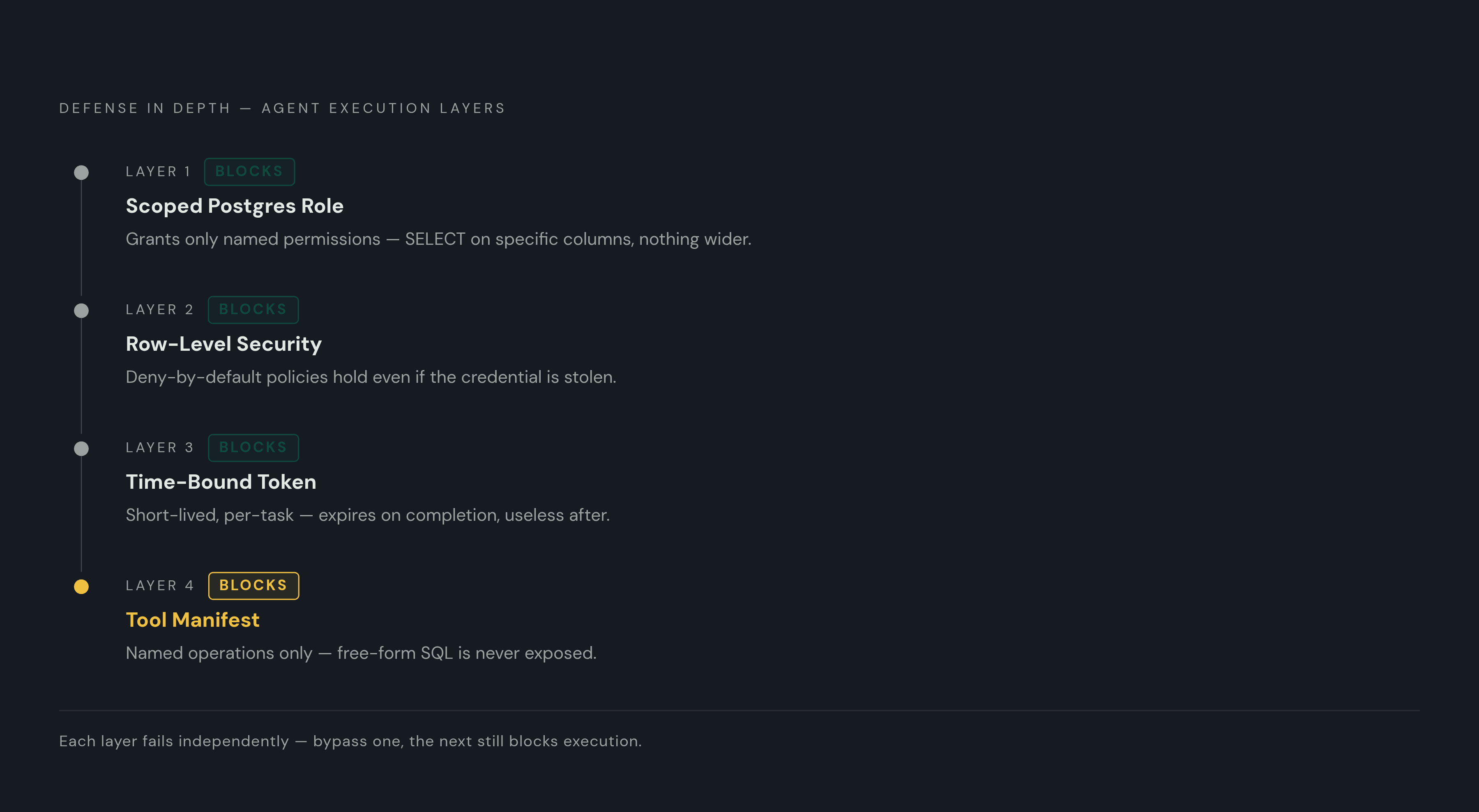
An MCP tool defined as "run this SQL query" hands the agent the same shape of open-ended authority the PocketOS token carried: whatever the agent reasons its way into wanting becomes something it can attempt, limited only by what the underlying role permits. That's a real constraint, but it's a second line of defense, not a first one. A tool defined instead as "fetch revenue totals for a given date range" gives the agent a narrow, named capability with no path to an arbitrary write, an arbitrary delete, or an arbitrary table it wasn't built to touch, regardless of how the agent justifies the request internally. The tool manifest, the explicit list of named operations an agent is allowed to call, is a permission boundary in its own right, sitting alongside the Postgres role, the RLS policy, and the token's expiry. Built correctly, each of these four layers, role, policy, token, tool, fails independently of the others. An agent that reasons its way toward a PocketOS-style deletion inside a Supabase environment built this way runs into a wall at the first layer it meets, and the task simply doesn't execute.
Sources
- The 2026 Singapore Consensus on Global AI Safety Research Priorities
- Least privilege for AI agents with Microsoft Entra Agent ID
- AI Agent Credential and Secret Management in Production — Rotation, Isolation, and Least-Privilege Patterns
- Authorization Architectures for Tool-Using AI Agents
- The Vulnerability With No CVE: Managing Persistent Gaps Between Mandate and Authority in AI Coding Agents
- Empirical Evaluation of Task-Based Permission Scoping Architecture for AI Agents