Choosing an MCP Server That Shields Supabase Production From AI Agent Query Load
Protect Supabase from AI agents with per-agent identity, pooling, and query governance.
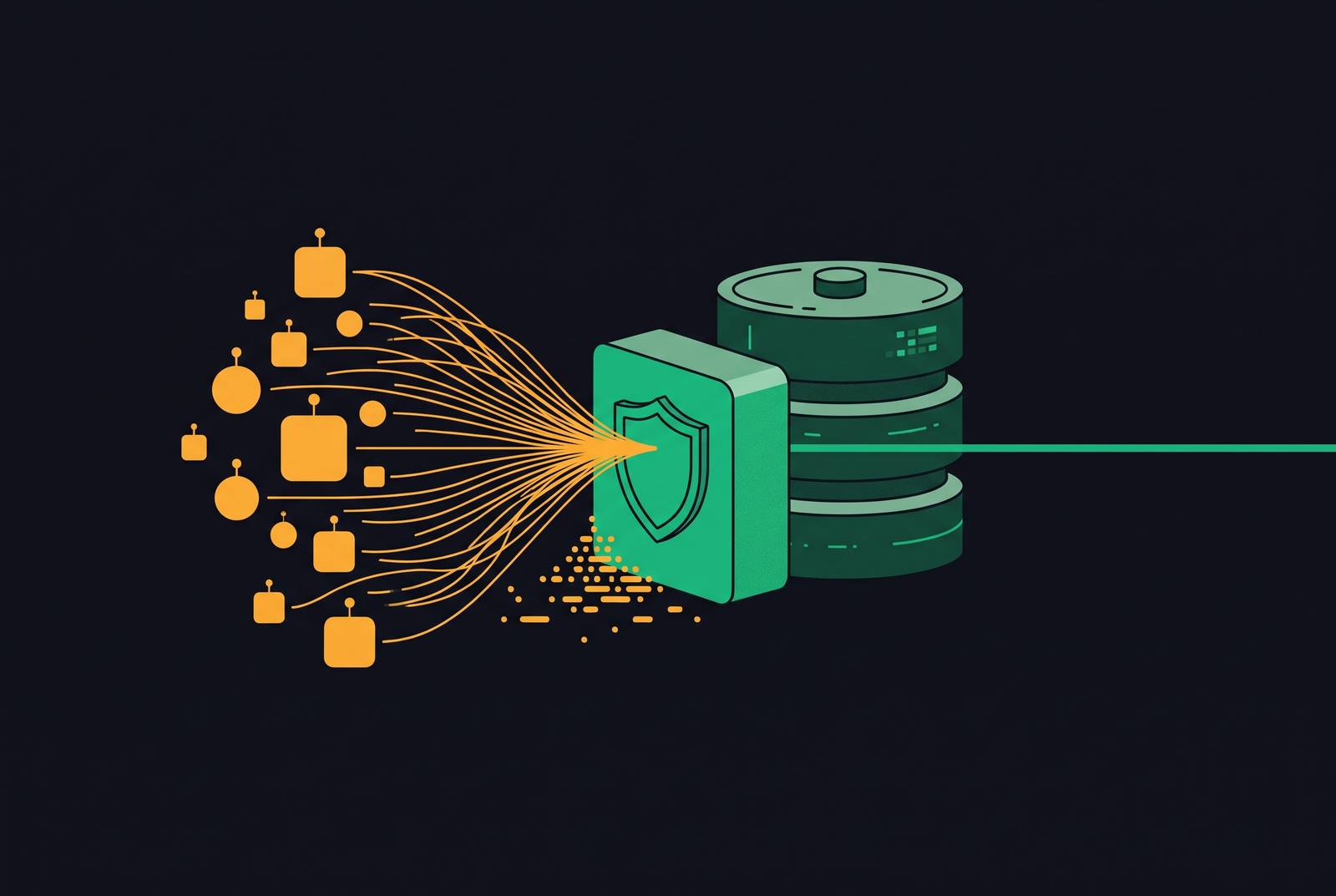
Governed data access for AI agents on Supabase via MCP requires more than a database connector. Choose a server that has per-agent identity, pooled connections, and read-only dataset separation, and that enforces query governance before queries run and before results reach the model. For analytics, give agents pre-defined metrics through a separate governed read path so they never query live production tables.
Why MCP servers expose Supabase production databases to a new class of query risk
Application code usually sends narrow, predictable queries to a database. AI agents instead issue exploratory bursts, including schema introspection, multi-table joins, and broad reads. That difference changes the load Supabase must absorb. A connection that works for a backend request can become a route for repeated exploration against the same production resources. The workload creates query risk regardless of the protocol used to deliver it.
A raw MCP server adds to that risk by giving agents the same shared connection string, with no per-agent identity, scope limits, or masking. Agent traffic then becomes indistinguishable from application traffic. Supabase runs on Postgres, which has a fixed connection limit, while serverless functions open a new connection per invocation by default. Bursts of agent queries can therefore use up the connections within seconds of a traffic spike. The application shares the consequences even when its own query patterns have not changed.
Four ways a default MCP connection harms a live Supabase database
Without a pooler, bursts of agent invocations consume max_connections. Beyond a high utilization threshold, the database becomes unstable for every workload sharing the instance. This is an availability problem, even when every query is authorized.
A full-table read can put every email, token, and secret from a users table into the model context, logs, and downstream tool calls. Raw MCP connections provide no masking on that path. Supabase Row Level Security also needs care, because views that agents create without security_invoker = true silently bypass those policies.
An agent with update access and no row filter can mutate every row in one tool call. Bytebase's MCP documentation identifies the gap as a raw server allowing DROP or UPDATE without approval, SQL review, a rollback path, or a record of what changed.
Malicious instructions inside database rows can induce disclosure, unauthorized commands, or credential propagation into another system. MCPHunt documents a cross-tenant isolation flaw in Asana's MCP server and a prompt injection against the official GitHub MCP server that enabled private repository exfiltration.
Why the fragmented MCP server ecosystem makes this worse for teams choosing off-the-shelf options
MCPHunt's 2026 analysis describes an ecosystem of over 10,000 public servers. Most databases have no single canonical, production-blessed MCP server. Teams therefore face a selection problem before they face a configuration problem, often choosing community implementations whose security posture they have not audited. The connector becomes a privileged third-party participant in the data path, holding production credentials and executing queries as the connected user.
The MySQL landscape illustrates how widely defaults can differ. Oracle's first-party server is labeled “not intended for production use — a proof of concept,” while other implementations range from read-only access to full DML. Some expose execute_sql without filtering statement types. Separately, Oracle's SQLcl MCP server reuses saved connections and stored credentials, so an agent inherits the developer's configured privilege level, potentially including DBA rights.
The Custody Envelope Threshold framework describes weakly governed access to high-authority artifacts as governance debt. A server that can read, write, or exfiltrate production data needs more scrutiny than its installation process may suggest. Weak identity controls and no revocation path become difficult to defend when a team scales or faces an audit. Selection must therefore turn on enforceable architectural properties, rather than whether a server can successfully answer a test query.
The four architectural properties that make an MCP server production-safe
Per-agent identity is the first required property. Each agent needs access that can be attributed, scoped, and revoked independently. The MCP specification's March 2025 revision introduced OAuth 2.1 as a standardized authentication layer, replacing the earlier ad hoc consent model. Production-safe servers should conform to that standard. Without distinct identities, incident response cannot selectively remove one workflow's access.
Connection pooling is the second required property. Supavisor, Supabase's built-in pooler, should sit between agents and Postgres for agent traffic that needs database access. Routing through it is a configuration choice. Pooling addresses connection pressure, while query observability addresses the load those connections deliver. pg_stat_statements, enabled by default on most managed Postgres, records mean execution time, total execution time, and call count, making it the primary tool for detecting agent-driven query load before an outage.
Read-only dataset separation is the third required property. Analytics queries belong on a separate read path rather than production Postgres, because read permission does not make an expensive query harmless to application performance. Agent workflows should default to local or staging databases. When production access is genuinely needed, temporary-token previews combine a scoped database role with an expiry window.
Query governance is the fourth required property. Bytebase intercepts queries and results, dynamically masks sensitive columns by agent role, and lets administrators set the maximum session action to Disabled, Read-only, or Read-write. Read-write changes still face the SQL review required of human changes. Complete mediation means every request is checked against policy, with high-impact actions held for human approval. Microsoft Foundry's MCP governance documentation describes an AI gateway enforcing authentication, rate limits, IP restrictions, and audit logging without changing agent or server code, although the gateway does not log tool traces.
Why analytics agent queries need a separate governed read path, not just a safer connection
Pooling and masking do not turn production Postgres into the right destination for analytics exploration. KPI lookups, aggregations, and trend queries need a different architecture. A founder currently asking engineers to run custom SQL against production should not replace that engineer with an agent using the same unrestricted path. The safer replacement is an agent consuming a pre-modeled metrics layer, with query load removed from production.
Headless BI separates metric definitions from dashboards and reports. ARR, churn, and CAC are defined once as code in a centralized semantic layer, then exposed in a machine-readable format through a governed API. Dashboards, reporting tools, and agents all use the same definitions. This prevents the agent from inventing business math for each question. Its CAC calculation matches the finance team's because both use the same definition of the metric.
Modern headless BI platforms support MCP natively, so agents can request metrics through the governed layer dashboards use. A monthly CAC question should resolve against a pre-defined, cached metric. It should not trigger raw SQL against production orders and customers tables. To keep agents off live Postgres entirely, that governed read path must also be separate from production, rather than merely placing a friendlier interface over live tables.
This architecture replaces ad-hoc SQL with shared definitions and removes production analytics reads from workflows that may also write to other systems. The assembly still requires decisions about identity, permissions, and metric maintenance. A productized done-for-you model fits founders who need trustworthy numbers quickly and safe agent access, rather than teams that want to assemble the infrastructure role by role.
What cross-boundary credential propagation means for multi-agent Supabase deployments
Carefully scoped agents can still form an unsafe workflow. Individually benign read and write permissions can combine into credential propagation when data crosses from one tool to another. MCPHunt found policy-violating credential propagation rates of 11.5–41.3% across five models in controlled multi-server deployments. Across thousands of traces, credentials crossed trust boundaries as agents carried out their tasks as instructed. The workflow topology, rather than malicious model behavior, created the route.
For Supabase teams, the distinction is operationally important. One agent may read database content while another writes a Slack message, a file, or an external API request. Each agent can stay within its stated tool permissions while the workflow as a whole moves sensitive content across a boundary. Prompt instructions cannot reliably close that route. MCPHunt's prompt mitigation study reduced propagation to as low as 0.3% in one configuration, but effectiveness varied across models.
Infrastructure must therefore enforce the boundary between permitted access and permitted onward disclosure. The custody framework calls for strong object identity, controlled ingress, and fast revocation before high-authority artifacts cross an institutional boundary. Where direct custody cannot be established, it prescribes proxying, mediation, or internalization. Applied to MCP, that places responsibility on the governed data path, rather than on an agent's description of its intended scope.
The objection that governance slows agents down, and where it actually holds
A governance layer can add latency, a semantic layer needs maintenance, and restrictive policies can block workflows that legitimately require flexible access. However, unrestricted access leaves teams exposed to undetected data loss or production corruption without an audit trail. Productivity cannot be judged only by the speed of a successful tool call.
Short token lifetimes, branch-first database changes, diff-first review, and human approval before production writes preserve useful work while limiting its reach. Analytics has a separate maintenance obligation. MCP servers are connectors, so they do not fix data quality, normalize schemas, or turn raw API responses into reliable metrics. A governed connector without a maintained metrics layer leaves that problem unresolved.
The custody framework scales governance with delegated authority. A read-only query against a non-production replica with no PII can need only light controls, while the ability to write to production with a shared credential calls for strong identity, controlled ingress, and fast revocation. MCPHunt's prompt mitigation study preserved most agent utility while reducing policy-violating propagation by up to 98%, although that does not make prompts a substitute for infrastructure controls.
What should teams look for in an MCP server for production Supabase use?
Evaluation should first establish whether every agent authenticates as itself. A shared connection string fails the attribution and selective-revocation test, regardless of how convenient setup appears. Bytebase is a relevant option for governed database reads and changes because its documented controls include per-agent identity, scoped access, and agents that never hold database credentials. That role differs from Supavisor's pooling role and Foundry's gateway role. These are complementary layers.
All agent traffic that reaches Postgres should go through Supavisor, while analytics requests should use pre-calculated, cached metrics from a separate governed read path. A pooled production connection is not analytics isolation. For row-level access, evaluation must also account for views that bypass Supabase policies unless security_invoker = true is set. A server cannot be judged safe solely because Row Level Security exists on the underlying tables.
The final questions concern what can leave the database and what can change it. Role-based column masking must occur before results reach the model, because PII, PHI, and secrets cannot be unread once they enter context. An administrator must set session authority, and the server must enforce it. Read-write sessions should need the same SQL review and approval as changes made by humans, and high-impact actions should be held before they run. Selection depends on enforcement of those boundaries throughout the workflow.