Data Contracts Between AI Agents and Postgres Schemas
Agents need semantic contracts with Postgres, not just schema validation.
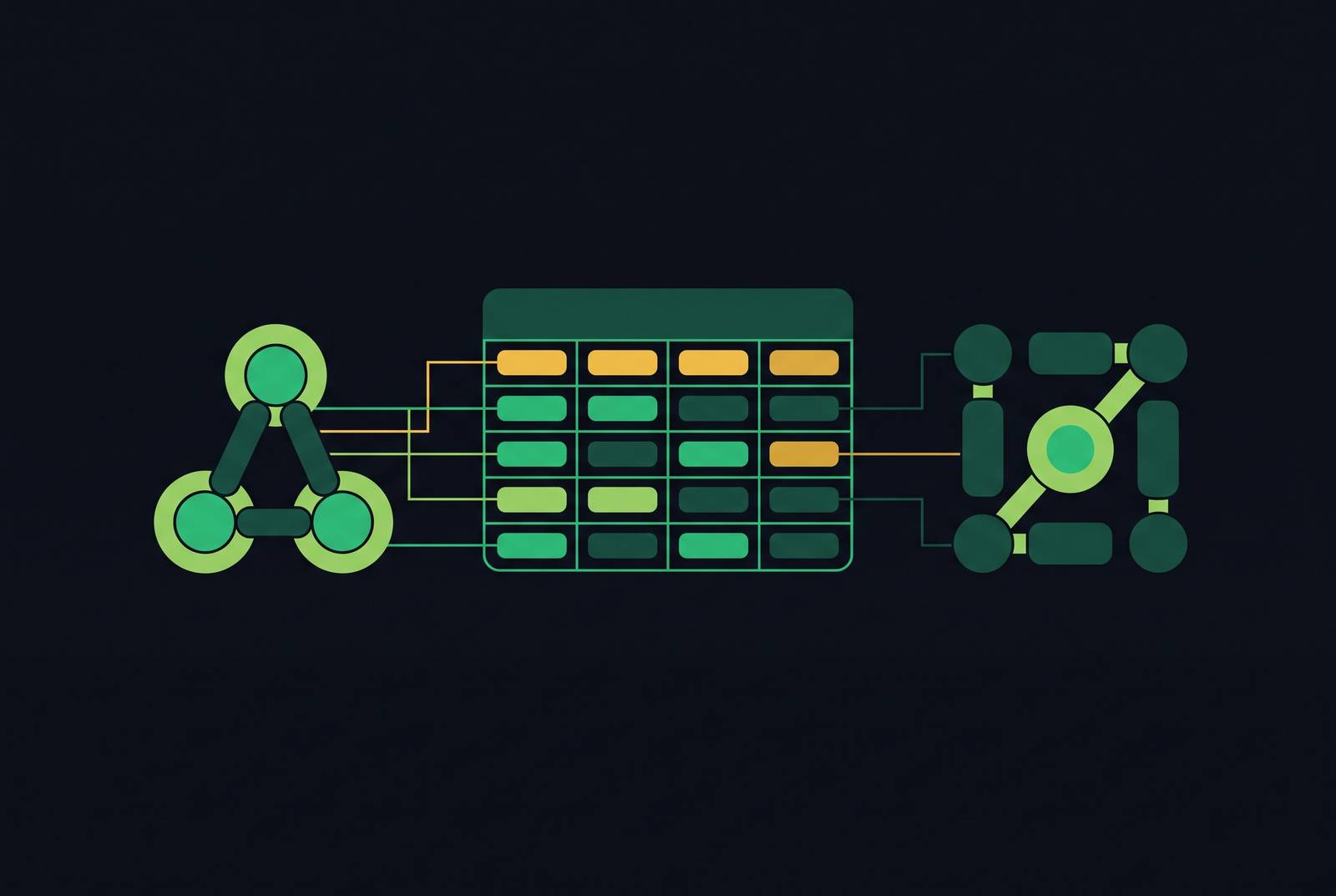
A Postgres schema tells an agent what columns exist and what types they hold. An agent needs more than that before it can act on the data. The gap between those two positions is where failures that pass every structural check end up as confidently wrong decisions, and no amount of model quality closes it.
Why a Postgres schema is not enough of a contract for an AI agent
A schema is a structural guarantee, not a business guarantee. It certifies that a field is named status and holds a string, which tells an agent precisely nothing about whether that string means "payment settled" or "order confirmed." A migration can shift that meaning without altering the column name or type, and every structural test in a traditional pipeline will pass. The schema has not failed, because it was never asked to certify meaning in the first place. That omission is precisely what agent workloads expose most sharply.
Human-reviewed pipelines absorbed this ambiguity by accident of pace. A number that broke a downstream report could sit unnoticed for a full cycle before someone escalated, and the cost of the delay was a stale dashboard that a person could look at and question. What used to be a broken dashboard is now a confidently wrong AI decision, the kind that AI agent hallucination research traces back to bad or stale context rather than a flawed model. The model was never the variable that moved.
The concrete failure shape is worth naming because it has no natural visibility. No stack trace points back at the semantic drift, because no test was written to catch it. The schema was the starting point, and the system treated it as the finish line.
What a well-formed data contract actually covers in a Postgres-native context
A complete data contract for a Postgres-backed agent system has four components: schema, quality rules, semantic meaning, and access policy with freshness SLAs. The schema is enforced by the pipeline because that is what database tooling does. The other three live in documentation, spreadsheets, and tribal knowledge, where agents cannot reach them.
The Open Data Contract Standard framing is worth importing directly here. It defines a data contract as a document covering the ownership, structure, semantics, quality, and terms of use for data exchanged between a producer and its consumers. Swap "data producer" for "an LLM or agent step" and the mapping is complete. The agent is a consumer whose retrieval and application of data are exactly as consequential as a downstream dashboard's, but whose speed of consumption leaves no room for a human to catch what the contract failed to specify.
Semantic meaning is the component most organizations skip, and it is the one that separates documentation from enforcement. A field definition that lives behind an API endpoint can be validated at inference time, before the agent builds a decision on top of it. That validation step is what turns a contract from a document someone wrote into a boundary the system enforces.
Freshness SLAs distinguish AI-ready contracts from BI-era ones. An agent making a decision about inventory, money, or customer experience cannot make that judgment call, and a contract that does not specify a maximum data age cannot be enforced at all. Every one of those serves either enforcement or accountability.
How semantic drift breaks agent decisions silently and at scale
Semantic drift is the most dangerous failure mode in agent systems because it is invisible to every structural check and amplifies silently across every downstream decision. A field's meaning changes without a schema change, and the system has no way to tell a new valid reality from a broken pipeline. The agent applies whatever meaning it infers, produces a confident output reflecting a reality that no longer holds, and never knows it was wrong.
The customer-support agent example is the clearest illustration. An agent can see the old subscription plan, apply the wrong refund policy, and explain the decision in perfect English. The model did exactly what it was asked with the context it was given, and the context was wrong in a way no type check could have caught. That is the point: the model's behavior is the most predictable part of the stack, and the data is the part nobody certified.
The failure appears in one of three ways, and none of them surfaces a useful trace. An agent pipeline that receives a malformed tool result often keeps going, with the model improvising around the gap and downstream steps consuming the improvisation. The failure surfaces several hops later, if it surfaces at all.
The definitional problem starts before any agent is involved. The practical fix is a semantic layer that translates raw data into clear business metrics and defines complex calculations like MRR or LTV in one central place. For agents, that layer must be machine-readable: a queryable endpoint consulted at inference time, not a documentation page the model cannot read.
Why freshness is a contract term, not a pipeline property
Treating data freshness as a pipeline concern rather than a contract term means agents inherit staleness without knowing it. And the default architecture underneath many agent demos is a batch ETL job that made sense when the end user was a human looking at a dashboard. An agent cannot make that judgment call, because it has no judgment standing outside the context it was given.
A financial agent working from yesterday's positions may generate actions that are already invalid. These are not edge cases. They are the default behavior of a batch-backed agent system. The freshness problem compounds because the agent cannot distinguish an old value from a current one without the contract telling it the boundary, and it will not ask a question that is not in its prompt.
The recommended infrastructure pattern is Change Data Capture off Postgres's Write-Ahead Log, threading changes through to agent-facing layers without touching production directly. The pipeline between Postgres and the systems that feed agents becomes part of AI correctness, and that pipeline needs CDC, freshness visibility, safe replication-slot management, delete propagation, schema evolution, and observability. A freshness SLA inside a contract specifies the maximum age of data the agent is permitted to act on, and the behavior when that threshold is exceeded: pause, flag, escalate, or refuse. It does not leave the decision to the agent, because the agent is the component least equipped to notice the violation.
Enforcement of freshness belongs at inference time, not only at ingestion. AI-ready contracts enforce at context delivery instead, checking the data's age as it is handed to the model and applying the contract's specified response before a decision is built. The agent never queries a production table where freshness is unknown. It queries a governed dataset where the contract specifies exactly how old the data can be.
Access policy as a contract enforcement layer, not a database role
Database roles tell an agent what tables it can reach. A contract-level access policy tells an agent what it is permitted to do with those tables, and only the latter prevents the failure mode where an agent with read access confidently returns data it should never have seen. The agent can retrieve every column and every row the role permits, and then it can do whatever its reasoning leads it to do with that data.
The governance failure that anchors this argument is easy to picture: an agentic failure looks like an over-eager intern equipped with administrator credentials, unbound by human oversight, operating at machine speed against a persistent connection to corporate infrastructure. The broad, ungoverned agent access that has become common across Postgres projects produces missing indexes, RLS bypasses, and connection pool exhaustion at a scale that database teams never had to handle when the only consumers were dashboards. The agent-skills release acknowledges these failure modes directly, and they are exactly what happens when a role-based permission model meets an inference-speed workload.
The mitigation is attribute-based access control enforced at query time, not schema creation. A fraud detection agent can see transaction amounts and timestamps without seeing payment card numbers or customer names, not because it lacks database access but because governance filters the return at the moment of retrieval. That distinction is the whole point: the contract is what protects the data, not the role.
For a policy to be enforceable it must be machine-executable. A policy stating "DENY SELECT * queries returning more than 100 rows from the customer_data schema for agents without explicit bulk-access certification" can be. Exposing a governed, read-only layer is not a workaround but the correct architectural pattern: production is the source of record, not the query target.
How MCP fits into the contract stack without replacing it
MCP standardizes how agents access data and actions across systems, and that standardization is genuinely useful. But an agent connected by MCP to uncertified tables still gets confidently wrong answers, because MCP moves data and actions to the agent without making the data correct. The contract must exist before MCP makes it useful, and the two solve different problems.
The protocol's architecture is a three-layer separation: the AI client, the MCP server, and the resource behind it. It is not a substitute for semantic contracts at the data layer. The common mistake in 2026 is assuming MCP replaces the need for clean data or a semantic layer, when it does neither.
Structured Outputs and strict tool use push enforcement closer to generation time in a way that complements the protocol layer. Anthropic's strict tool use, enabled via strict: true on a tool definition, guarantees Claude's tool inputs match the declared JSON Schema. These are contract enforcement at the token level, not contract definition. They ensure the agent's outputs are shaped correctly, but they cannot correct a wrong value in the data the agent consumed.
The full stack of enforcement is additive, not redundant. Token-level constraints at the model vendor, protocol-level schema at MCP, application-level validation with Pydantic and dbt, and semantic-layer enforcement at inference time each remove a class of failure the previous layer can only detect, not prevent. MCP is the courier, not the certifier.
Governed, pre-modeled datasets as the right enforcement point for Postgres-native teams
For Postgres-native teams, the most practical enforcement point for all four contract components is a governed dataset layer that sits between production and any agent consumer, rather than contracts enforced piecemeal at the agent boundary. A governed layer enforces schema, semantics, freshness, and access in one place, and every consumer reaches it through the same door. The freshness problem is solved structurally, because the agent never queries a production table where freshness is unknown. The semantic problem is solved by definition. There is no way for an agent to apply a different interpretation of ARR than the finance team applies, because both consume the same pre-calculated value.
The access problem is solved by separation. Agents never touch the production database, so RLS bypass, connection pool exhaustion, and runaway SELECT * queries are structurally impossible. A single MCP server exposing this governed layer means the contract is enforced at every access point. No agent reaches around it to the raw tables, and no human dashboard pulls a different version of the metric.
The no-data-team implication matters for the teams this pattern is actually for. The contract is the layer, and the layer is the product. That is the architecture's real promise: enforcement without a dedicated governance team, because the enforcement point is the same artifact every consumer reads.
Implementing contracts in practice: versioning, violation policy, and schema evolution
A data contract without a versioning strategy and an explicit violation policy is documentation, not governance. The implementation decisions that make a contract enforceable are versioning rules, violation routing, and schema evolution handling, and each must be decided in advance. Teams that defer these decisions until the first incident are deciding them under pressure, which is the worst time to make policy.
Versioning rules are straightforward when stated as rules. Deprecate with a date and log usage by version so owners know when the prior version can be retired. These rules prevent the silent breakage that agents are most vulnerable to.
Violation routing must be decided before deployment, not after the first incident. Schema drift fails the build, stopping the pipeline rather than allowing drifted data to reach agent consumers. Each of these responses is a policy choice made once and enforced mechanically.
Schema evolution for agent systems requires automated impact analysis. The CDC layer handles Postgres-side evolution, with safe replication-slot management, delete propagation, and schema evolution observability as first-class operational requirements. The pipeline between Postgres and the governed dataset layer must track these concerns continuously, not as an afterthought.
The tooling that transfers from data engineering practice is familiar. dbt fails the build on contract mismatch. Great Expectations validates content beyond shape. These are not new tools but established ones applied at the agent boundary, which is exactly where the enforcement point has moved. The 4-layer context correction approach for Postgres agent safety, presented at POSETTE 2026, addresses the common agent failure modes through schema, semantic, relationship, and safety layers, treating hallucination, semantic misunderstanding, and missing guardrails as problems a context architecture can correct rather than problems a model must be retrained to avoid.
For teams starting out, the minimum viable contract is a read-only governed layer with explicit violation routing. The point at which a contract becomes governance is the moment its violations produce a defined response rather than a plausible improvisation. Everything before that moment is architecture. Everything after it is trust.