AI Data Sprawl and the Governed Data Layer
A governed data layer enforces authorization before AI agents access production databases.
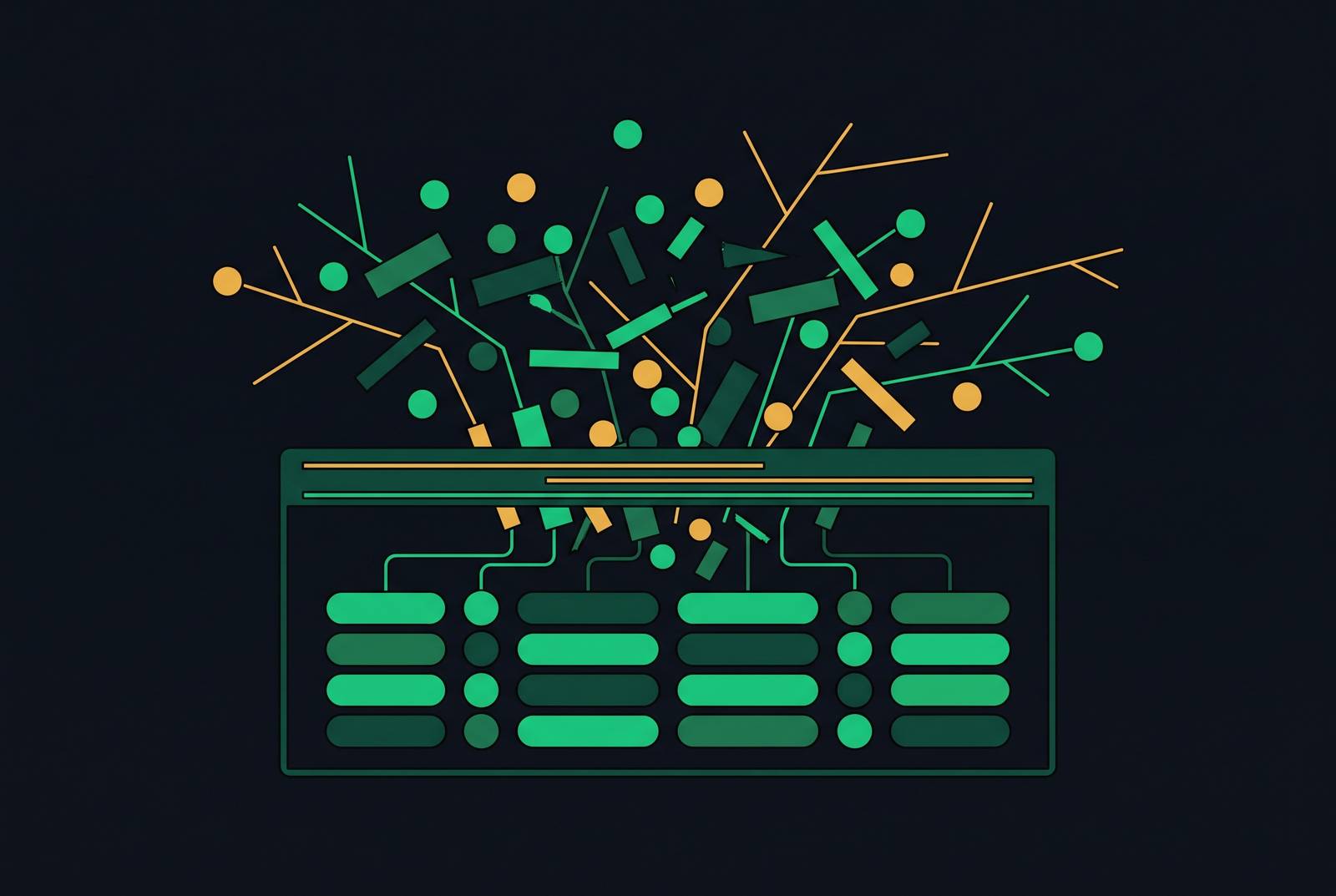
AI data sprawl grows when agents get to production data through pipelines that have no shared governance boundary. A governed data layer puts authorization, shared definitions, and current data between agents and source systems, so each consumer can use the same infrastructure stack.
Why AI agents are landing directly on production databases
An agent connects to a production database, a table is reachable, and a query runs. This is the fastest path to a working application because the data is already there. A governed intermediate layer adds friction before it delivers an obvious benefit, so early-stage teams have little incentive to build it first. Liquibase's 2026 analysis found that AI now touches production databases in 96.5% of organizations.
The missing boundary lies between the agent choosing an action and the tool executing it. The OAP paper identifies no standard mechanism for enforcing per-action authorization before a tool call executes. Model alignment is probabilistic, and application-layer validation is ad hoc, so neither is a security-grade boundary. When teams run agents outside a managed platform, those agents also skip the governance controls set up on that platform. This is the mechanism behind the new shadow IT, where useful connections spread without a corresponding enforcement layer.
What data sprawl actually means when agents are in the loop
As agents spread across database types and unmanaged copies, they create more uncontrolled access points than teams can audit. Each path extends the authorization gap into another part of the architecture. Unmanaged copies also let agents read data that may be stale or have a different definition elsewhere.
Pipelines are versioned and logged, while people have defined roles. Agents are non-deterministic, traverse data at speeds no human can monitor in real time, and do not independently surface destructive changes. The OAP paper documents 492+ MCP servers exposed without authentication or encryption in production. It also documents a supply-chain attack in which approximately 20% of one skill registry's entries, comprising 824+ skills in the OpenClaw skill registry, were injected with prompt injection payloads and token exfiltration routines.
The OAP paper cites an industry study that found the vast majority of government organizations have no purpose-binding controls for AI agents, and fewer than half of organizations across all industries use them. A read-only agent can still leak PII, consume production compute, and produce inconsistent answers from ungoverned data. Preventing writes limits one class of action, but it does not govern the data the agent sees or the resources it consumes.
Why the problem is structural, not a matter of team discipline
The diagnosis turns on where the authorization decision is made. A model can be persuaded, and application-specific checks do not provide a common enforcement boundary. Authorization has to operate at the tool call boundary, where a policy can deterministically permit or deny an action before execution. More careful development cannot substitute for that boundary when the architecture leaves it absent.
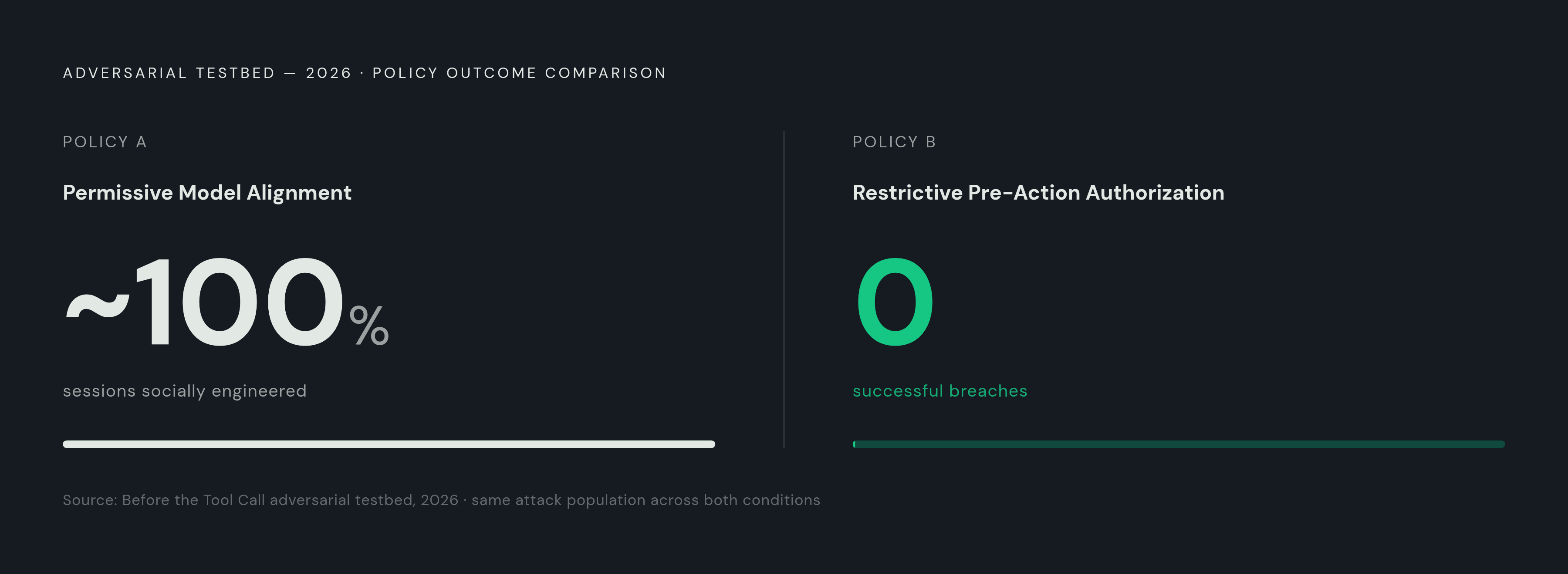
Before the Tool Call's 2026 adversarial testbed makes this distinction concrete. Under a permissive policy, social engineering succeeded against the model in the vast majority of sessions. With a restrictive pre-action authorization policy in place, the same attack population had zero successful breaches.
Multi-agent systems make the boundary more important because delegation chains, context isolation, and no-privilege-escalation are hard requirements. Model training alone cannot satisfy them. Business owners must decide what agents may do independently and what requires human approval, rather than leaving developers to make those decisions implicitly. Without that governance structure, agents have full autonomy by default. Those decisions need a point in the architecture where they are enforced because agent behavior varies and one-time pass/fail tests cannot make it safe.
What MCP actually is and what it does not solve
MCP standardizes how agents call tools and access resources. That makes it useful integration infrastructure, but it does not itself supply identity, semantic grounding, query performance, lineage, cost controls, or auditability. A standard interface answers how a request reaches a tool. A governed data layer permits or denies that request and controls what data context the tool exposes. Treating the two as interchangeable leaves the original authorization gap intact.
The July 28, 2026 stateless spec revision, the largest change since launch, fixes a problem with how servers are deployed. A remote MCP server that used to need sticky sessions and a shared session store can run behind a plain round-robin load balancer. Removing that session dependency improves scalability and resolves session-layer attack surfaces. It does not close prompt-level or supply-chain threats.
MCP therefore belongs above the governed layer as its delivery mechanism. An agent with direct table access through MCP still has to guess at business meaning when it has no semantic context. An agent receiving governed, pre-modeled context has defined material on which to base its answer. The interface remains valuable in both cases, but the quality and control of the underlying data determine the difference.
What a governed data layer actually consists of
A governed data layer sits between agents and source data, enforcing identity, pre-action authorization, semantic definition, lineage, and freshness before queries execute. Its authorization control intercepts tool calls synchronously. The OAP paper describes policy evaluation and a cryptographic audit record before execution. This creates an enforceable boundary between a proposed action and a permitted one. Post-hoc evaluation can review what an action did, but it cannot decide ahead of time whether to allow it.
Access within this boundary is scoped to the task. Each agent should run in an ephemeral execution environment with a network allowlist, expiring tokens, and scoped IAM. Access ends when the task ends, instead of persisting as standing database credentials. Data-layer policies must also apply wherever the data lives. Otherwise, permissions, masking rules, and regulatory requirements differ from one surface an agent can reach to another.
The layer must also expose pre-modeled datasets with metric definitions, dimension relationships, freshness metadata, and ownership context. Raw schema alone leaves agents to infer meanings that may differ from one answer to another. Semantic grounding makes those meanings explicit before the agent reasons over the data. Lineage records where the data came from and how it changed before reaching the agent, while version control makes results reproducible afterward. Together, these mechanisms make the answer explainable in terms of both its business definition and its data history.
Why Postgres-native teams face a specific version of this problem
For Postgres-native teams, the direct connection creates a workload mismatch as well as an authorization gap. The instance serving an application is row-oriented and tuned for transactional work. Analytical and agent-serving queries scan and aggregate across large swaths of rows, competing with live traffic for the same CPU and memory. The compute is the wrong shape for the new workload. A read replica resolves contention, but it does not change that shape.
Supabase teams also encounter RLS friction, pooler limits, and charting that handles nested document data poorly when running analytics on production Postgres. Security defaults differ by how tables are created, since tables created through the Supabase UI ship with RLS on, while those created through SQL migrations or external tools ship with RLS off. The service_role key is also commonly committed to repositories or bundled into deployed frontends by accident.
The business question soon reaches beyond Postgres in any case. Revenue by signup cohort, CAC against usage, and which flagged accounts churned cross Supabase, Stripe, ad platforms, and a CRM. Liquibase's 2026 analysis found that 29.1% of organizations are already managing ten or more database types. A dashboard tied to a single database cannot give KPIs a shared definition when they need multi-source joins.
The governed data layer as the architectural response that avoids new infrastructure complexity
A governed layer can sound like a commitment to a warehouse, a data team, ETL pipelines, schema migrations, and a new bill. For Postgres-native teams, however, the architectural response is an extension of the existing data foundation into analytical capability. The recommendation for teams crossing early scale is to replicate Postgres into a columnar, DuckDB-shaped analytical store, define metrics once, and point dashboards, AI, and APIs at that layer.
Pre-modeling data into governed Parquet datasets queryable via DuckDB gives that extension its practical form. Agents query columnar files that reflect the source of truth, leaving production tables untouched. Those files provide fast, cheap-to-query context without competing for OLTP compute. A single MCP server can then expose the pre-modeled datasets with metric definitions, dimension relationships, and freshness metadata. The underlying layer supplies the controls and context that the interface alone does not provide.
An agent, a dashboard, a Slack report, and a board deck share one metric definition. Three different MRR numbers become one because each consumer uses the same calculation. The tool registry, scoped IAM, expiring tokens, and audit records governing agent integration also govern human access. Shared controls avoid duplicating governance for the two kinds of consumer. The architecture reduces sprawl by consolidating access around governed datasets.
What safe agent-to-data access looks like in practice
Read-only agents used for search, retrieval, and summarization require least-privilege read scopes and audit logging. Task-based agents need fine-grained access control for each tool they are allowed to use. Workflow and cross-system agents require the full governance stack, including identity, policy enforcement, lineage, and cost circuit breakers. In production, the common foundation is verifiable identity, task-scoped permissions, and lineage records rather than inherited user privileges or standing database credentials.
Resource limits belong inside that access model. Token budgets, API call limits per session, maximum execution time per workflow, and cost circuit breakers set bounds on how much work agents can do and what it can cost. For Supabase teams, the service_role key must remain only in server-side environments and secrets managers. Continuous monitoring then tracks what agents do because their behavior changes from run to run. Audit records make post-hoc tracing possible, while pre-action enforcement remains responsible for deciding whether an action may execute.
Freshness completes the operating pattern. Agents making decisions that affect real money, inventory, or customer experience cannot work from data that is hours old, so the pre-modeling pipeline must run continuously. Supabase teams should define one source of truth for business metrics and enforce it at the data layer. Every consumer, whether an agent, dashboard, or report, should use that single governed surface. Current data and shared definitions together are the operational proof that the governed layer is doing its job.